Beyond the Dashboard: The DNA Tools That Turn Data into Discovery
Following the thread beyond the testing company. This is where genealogy research moves from interesting to serious — and, in my experience, more complex. The tools I share here are ones I have personally used or explored over the years. Some researchers find them intuitive. Others — like me — find them challenging, even intimidating at times. That’s okay. There are skilled professionals who specialize in interpreting this level of DNA data. I am not one of them. I am a learner walking the path. Still, this feels like the right point in my journey to share the tools that have helped me think more deeply about my results — how they work, what they reveal, and where they require caution. My hope is that by sharing them honestly, they may serve as guideposts for your own research.
DNA TOOLS
Wayne Driver
2/10/20263 min read
When I first tested my DNA, I did what most people do.
I logged into the dashboard.
I looked at the ethnicity estimate.
I scanned the match list.
I thought, “Well, that’s interesting.”
And then I realized something.
The real work — the meaningful work — does not begin and end with a colorful pie chart.
It begins when you download your raw data and start asking better questions.
Over the past year — especially as I’ve focused on my Y-DNA and my paternal line — I’ve discovered that interpretation requires tools, not just curiosity. It requires patience. It requires humility. And sometimes, it requires accepting that the answer may not be simple.
Below are some of the platforms and resources that have helped move my research from novelty to deeper analysis.
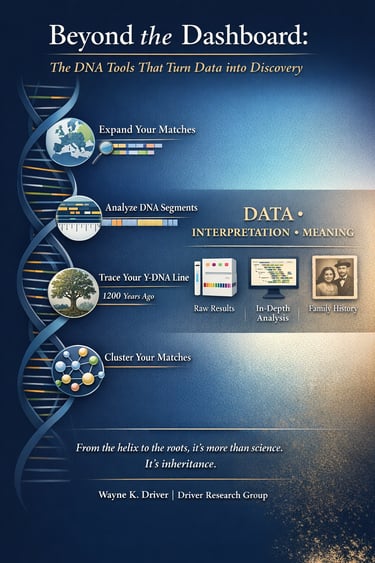
1. Expanding the Match Pool
The major testing companies are entry points. But serious analysis often requires broader comparison.
MyHeritage
https://www.myheritage.com/dna
MyHeritage allows uploads from other testing companies and maintains a strong European database. Its chromosome browser and AutoClusters feature are especially helpful for visually grouping matches.
If your lineage includes British, Irish, or continental European lines, this platform can be valuable.
FamilyTreeDNA
For Y-DNA research, this platform remains foundational. Their Big Y test refines haplogroups to a level that begins to measure time — not just geography.
Surname and haplogroup projects also encourage collaboration. When studying a paternal line, community matters.
2. Segment-Level Analysis
The dashboard tells you who matches.
Segment tools help you understand why.
GEDmatch
GEDmatch allows cross-platform comparisons. Its one-to-many match tool, triangulation features, and admixture calculators help move beyond surface-level relationships.
It requires patience.
But patience often reveals a pattern.
DNA Painter
https://dnapainter.com
Shared cM Tool: https://dnapainter.com/tools/sharedcmv4
DNA Painter lets you “paint” segments onto chromosomes to visually map inherited DNA. The Shared cM tool helps interpret relationship probabilities. The “What Are the Odds?” feature allows researchers to test genealogical hypotheses.
It turns theory into something visible.
When you see segments stack across generations, you realize this is not abstract data. It is an inheritance.
3. Y-DNA Deep Interpretation
My current focus has been the male line — the Y chromosome — the thread that runs father to son across centuries.
YFull
YFull analyzes BAM files and places results on a global YTree. It estimates the age of haplogroups and identifies private variants — mutations unique to specific lines.
This is where genealogy meets deep time.
When you discover that a branch formed 900 years ago, it changes how you think about your surname.
International Society of Genetic Genealogy (ISOGG)
Y-DNA Tree: https://isogg.org/tree/
Wiki: https://isogg.org/wiki
ISOGG maintains a volunteer-curated haplogroup tree and SNP index. When navigating naming conventions and updates, this resource provides clarity and technical grounding.
In Y-DNA work, precision matters.
4. Clustering & Pattern Recognition
Sometimes the question is not, “Who matches me?”
It is, “Which matches belong together?”
Genetic Affairs
AutoCluster reports group matches who also match each other. Patterns begin to emerge. Branches separate. Connections strengthen.
Clusters often reflect ancestral couples.
When several matches triangulate and cluster, you begin to see the architecture of your family tree taking shape.
What I’ve Learned
DNA tools do not replace traditional genealogy.
They sharpen it.
A census record may suggest a father.
A Y-DNA SNP may confirm a lineage.
A triangulated segment may support a hypothesis.
But interpretation still requires discipline, humility, and restraint.
Not every match is meaningful.
Not every theory survives scrutiny.
And yet, the process itself has shaped me.
The more I study my Y-DNA, the more I recognize something deeper than lineage — continuity. The chromosome I carry today is not just biological material. It is a historical document written in mutation and time.
And as I continue researching, writing, and reflecting, I am reminded that discovery is layered:
Data
Interpretation
Meaning
Testing companies provide data.
These tools provide interpretation.
Purpose gives meaning.
Connect With Us
To stay informed about the latest research and discoveries, connect with us on our social media channels.
© 2025. All rights reserved.
Let's Keep In Touch