Building Your Online Tree
When you’re ready to build your online tree, there are some hard-won lessons I’d like to share. I learned many of these through trial and error, others by observing how fellow researchers worked. As someone who manages multiple trees and DNA results, I’ve developed some strong opinions—and a few pet peeves—that might help you along the way. Remember: building your tree is a critical step in genealogical research. It’s the foundation for analyzing DNA results, writing publications, and preserving family stories. Build your tree on solid rock, not shifting sand.
HINTSONLINE TREESVALIDATIONPROFESSIONALISM
Wayne Karl Driver
10/13/20252 min read
Starting Out
Over twenty years ago, when I began my family tree, there were no online genealogy sites. You either worked by hand, using a printed template, or used one of the early desktop programs. Those programs only held what you entered, but even that was a game-changer—it allowed for some reporting, analysis, and printing that saved time for researchers.
Then came the first online applications. Suddenly, trees could be stored in the “cloud,” shared, and even built collaboratively with others researching the same lines. These platforms also provided us with access to census records, newspapers, and other documents that previously required visits to libraries or genealogical societies. Research was supposed to become much simpler. Well… let’s see.
The Temptation of Hints
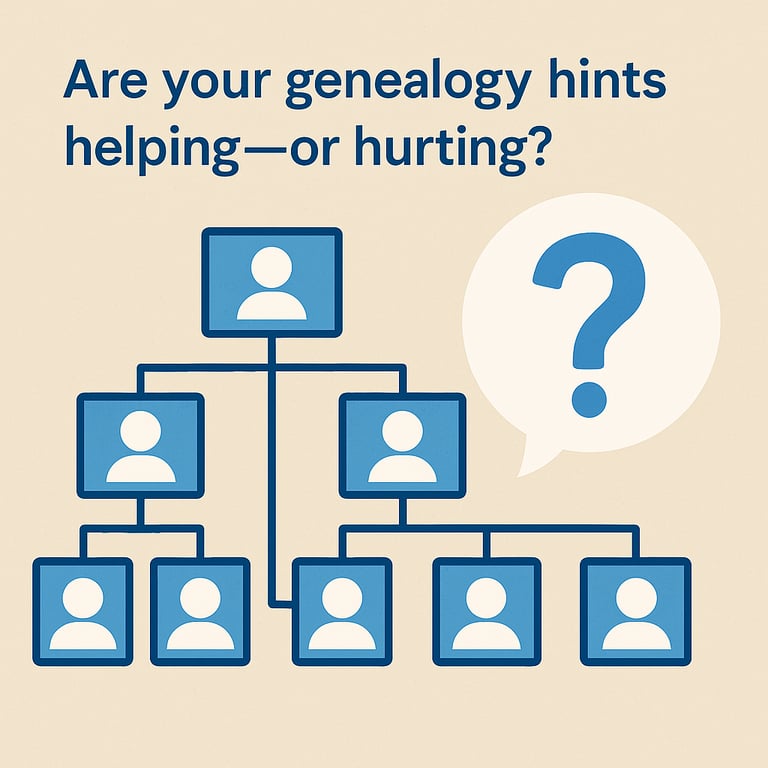
One of the most significant shifts introduced by online providers was the introduction of the “hint.” Hints help to connect us to someone else’s tree or notify us when a record might be a match. Fantastic, or so it seemed.
I’ll admit, I took the bait on several of those early hints. At first, they saved me time and effort. But one day, a fellow researcher reached out and told me that my work was flawed. Sure enough, they were right; the data wasn’t properly vetted. That experience taught me an important lesson: just because information is online doesn’t mean it’s accurate.
Early on, I often relied on “head knowledge” or family oral tradition. There’s nothing wrong with starting there, but it must be verified with solid research. Otherwise, your tree risks being built on shifting sand.
Lessons Learned & Pet Peeves
Over the years, others have entrusted me with their research. It has been both a privilege and an opportunity to refine my skills in research, analysis, and reporting. Along the way, I’ve noticed some common challenges—what I like to call my “pet peeves.”
Pet Peeve #1 – Professionalism in Communication
When contacting another researcher about a match or hint, be professional. Reference the tree name, provide details (names, dates, places), and respond promptly. Don’t make the other person drag basic information out of you—it’s unfair and discouraging.
Pet Peeve #2 – Be Open to Alternatives
Just because you knew someone as “Bessie” doesn’t mean her legal name wasn’t Elizabeth. Names, places, and even dates may have variations. Stay open-minded.
Pet Peeve #3 – Oral Tradition vs. Documented History
Oral history is valuable, but it doesn’t always align with the written record. I’ve shared several examples of this in earlier blogs. Be ready to embrace new findings, even when they challenge family lore.
Pet Peeve #4 – Learn to Document Like a Pro
If you haven’t done structured research since high school, it’s worth brushing up. Explore resources from professional genealogical organizations. Standards exist for a reason—and they save you time in the long run.
The Bottom Line
Starting your tree—or adapting your current one—using professional approaches is crucial for achieving better outcomes. Those unsubstantiated hints I once followed? It took me years to undo the damage. Save yourself (and others) the time and frustration. Build carefully, verify consistently, and document thoroughly.
Your future self—and future generations—will thank you.
What about you?
Are you an experienced researcher? What lessons have you learned while building your family tree? I’d love to hear your stories.
Connect With Us
To stay informed about the latest research and discoveries, connect with us on our social media channels.
© 2025. All rights reserved.
Let's Keep In Touch