My Maternal Roots — Known and Unknown
This post continues My Maternal Roots — Definitive Genes and Faith, which centered on my mother, Geraldine Willanet Jackson. Here, I explore both the well-traced and still-mysterious branches of her people. Researching my mother’s ancestors has brought moments of joy, clarity, and—at times—quiet disappointment. All of it has deepened my gratitude.
EASTERN SHORE VIRGINIA (ESV)CHESAPEAKE BAYCHINCOTEAGUE ISLANDACCOMACK COUNTYNORTHAMPTON COUNTY
Wayne Karl Driver
11/20/20253 min read
Introduction
I’ve already shared pieces of this story: The Legend of Johnny Irons (William J. Jackson), The Iron Lady (Josephine Mapp), and a three-part series on Appy Mapp. In this chapter, I follow other lines within Josephine Mapp’s ancestry—the Harmon, Hargis, Giddens, and Palmer families. Their trail leads to a place that has shaped our name and our faith: Virginia’s Eastern Shore, in Accomack and Northampton Counties.
Where is the Eastern Shore of Virginia?
The Eastern Shore is a slender peninsula framed by the Chesapeake Bay on one side and the Atlantic Ocean on the other. It moves to a tidal rhythm—barrier islands at Chincoteague, fields around Eastville, and the harbor at Cape Charles—a landscape of marsh, open sky, and long memory. Two counties—Accomack to the north and Northampton to the south—make up this region. By road, you arrive either from Maryland on Route 13 or across the Chesapeake Bay Bridge–Tunnel from Norfolk. That relative isolation forged a stubborn independence and a strong church life that still anchors families like ours.
As a child, I visited the Shore with my parents and grandmother during summer breaks. I remember potato and corn farms, tractor-trailers hustling up and down Route 13, and overnight stays with the Whartons and Trents. Back then, I didn’t appreciate what I was seeing. Now I do. When Tamara and I lived in Virginia, we returned to Chincoteague almost every year for rest and quiet—and yes, for Smith Island Cake and fresh seafood. Some places slow your breathing the moment you arrive; the Shore is one of them.
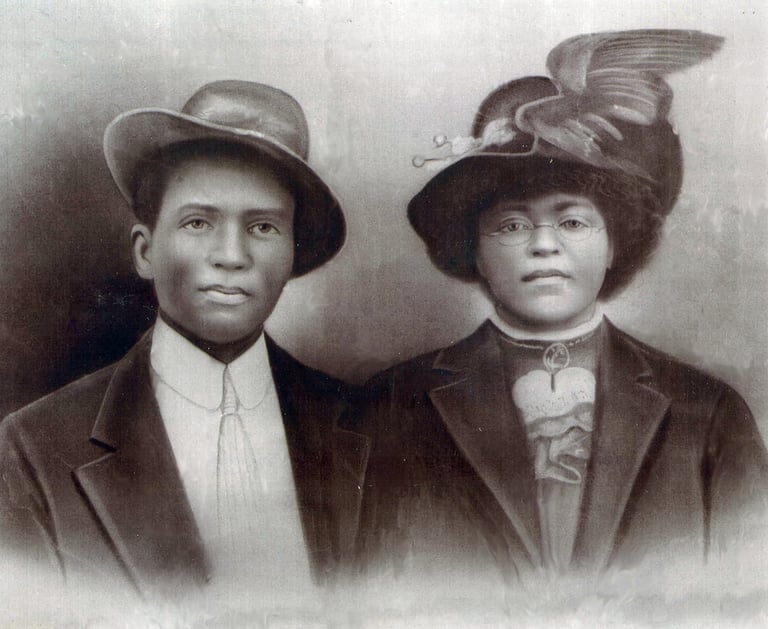
John D. Mapp & Maggie Susan Hargis Giddens
John D. Mapp, son of Appy Mapp and Mary Susan Harmon, married Maggie Susan Hargis Giddens, daughter of John William “Bill” Giddens (you’ll see Giddens spelled a few ways in the records). They had about twelve children, and many, including my grandmother Josephine, eventually migrated to Philadelphia. I didn’t grasp how large the Mapp family was until adulthood. After I moved to Virginia in the 1990s, I was invited to an Eastern Shore Mapp reunion—evidence that kinship on the Shore travels far and still circles back home.
Family History & Patterns We Can See
Studying individual death records across this line reveals shared threads—health, faith, marriage, and place—that speak to a close, resilient community.
🩺 Health patterns across generations
Kidney and heart disease (often listed as Bright’s disease, dropsy, cardiac failure) appear repeatedly, suggesting possible hereditary hypertension or diabetes.
Tuberculosis (as with John D.) reflects the post-WWI health crises that touched many Shore families.
Stroke / Cerebrovascular disease (seen in Florida West, Mary Mapp Mears, and Mary Susan Mapp) fits the broader cardiovascular vulnerability in this line.
⚰️ One resting place, many names
Nearly every record that names a burial ground lists Red Hill Cemetery, Keller, Virginia—the same place now known as Snead’s Memorial Methodist Church Independent (historically tied to Snead’s United Methodist). That continuity, from at least 1916 through 1965, testifies to a multi-generational Methodist identity. The churchyard holds our people’s stories in stone—some inscriptions worn, some markers missing, but the ground still speaks.
💍 Marriage circles
Among the spouses of Appy and Mary Susan’s children, the MEARS surname appears most often (Rosa, Mary, and Kate all married Mears men), with additional unions to Walker and West. These marriages knit together neighboring Black farming and watermen families who shared pews, fields, and fortunes along the Keller–Accomac–Pungoteague corridor.
🤝 Associated families you’ll meet in the records
Mears, West, Sample, Ames, Hatton, Francis, Drummond, Taylor, Custis—names that show up in deeds, church rolls, and cemetery lists alongside Mapp, Harmon, Hargis, Giddens, and Palmer.
On a visit to Snead’s Memorial Methodist Church Independent and its cemetery, I found many worn or unmarked graves—quite possibly the graves of relatives whose names have faded. Find a Grave currently lists ~393 burials there. The absences matter too; they urge us to keep looking.
A Note on Enslavement—and a Doorway Back
One document from our extended line mentions an enslaver by name. Edward Mapp (brother of Appy) has a death record that reads: “Appie Palmer (called Mapp by his owner).” That single line is a doorway—linking our family directly to the plantation system and pointing to Palmer records in Accomack County. It’s rare to find an enslaver identified in a death certificate; this clue will help future researchers push farther back.
Conclusion: What’s Known—and the One Unknown
The “unknown” that still tugs at me is my maternal grandfather, William Joseph Jackson, Sr. He’s the one branch that remains stubbornly quiet. Through DNA and continued digging, I believe the unknown will become known—if not for me, then for those who come after.
Do you have an “unknown” that haunts your tree? Keep going. Follow the churchyards, the small notes in the margins, the cousins’ stories. Light has a way of finding the patient researcher—sometimes in our lifetime, sometimes in the hands of the next faithful keeper of the family story.
Connect With Us
To stay informed about the latest research and discoveries, connect with us on our social media channels.
© 2025. All rights reserved.
Let's Keep In Touch