The Story of Race — A Historical Perspective
Race, as we know it today, has little to do with biology and everything to do with history, culture, and society. This post explores how the concept of “race” developed in the United States and why understanding that history helps us better interpret our ancestry and family records.
U.S. CENSUS
Wayne Karl Driver
12/19/20252 min read

Introduction
In my previous blog, My DNA Results — A Story Beyond Borders, I shared how our genetic roots can cross continents and cultures. Yet, as many family researchers soon discover, our ancestors lived in a world where labels like “race” shaped how they were counted, classified, and remembered.
While science confirms that all humans share 99.9% of the same DNA, history shows that “race” has carried deep social meaning. It has influenced where people lived, how they were treated, and even how their stories were recorded.
Let’s take a brief look at how this concept developed over time.
🕰️ 1790: The Beginning
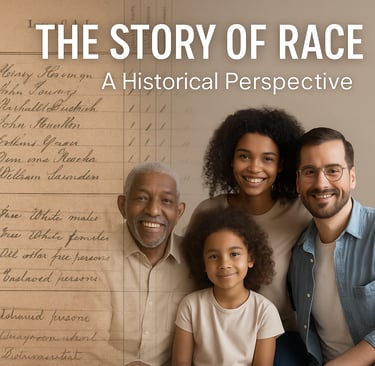
The first U.S. Census in 1790 — the same one that counted our early American ancestors — included categories based on color and status:
Free White males
Free White females
All other free persons
Enslaved persons
Although the term race wasn’t yet used, these groupings reflected how society viewed freedom, citizenship, and belonging. Early census records weren’t scientific; they were political tools meant to organize a growing nation.
⚖️ Why Race Was Recorded
The early inclusion of race wasn’t about understanding diversity — it was about defining population groups for government purposes.
Representation & Taxation: The census determined how many representatives each state received in Congress. Enslaved Africans were counted as three-fifths of a person under the Constitution’s compromise clause.
Population Management: Tracking racial data allowed leaders to monitor communities and measure demographic changes.
Classification Systems: Influenced by European ideas of the time, people believed visible traits could categorize humanity — a belief we now know is more social than scientific.
📜 How It Evolved
Over time, census categories shifted to reflect social attitudes:
1820–1840s: Added “free colored persons,” “Black,” and “Indian.”
1850: Every individual was listed by race for the first time.
1890: Introduced detailed mixed-race terms like “mulatto,” “quadroon,” and “octoroon.”
1930: Added and then removed “Mexican” as a racial category.
1970: Allowed people to select their own race rather than being assigned one.
2000: Permitted selecting more than one race, recognizing multiracial identity.
Today, census questions about race and ethnicity help reflect the nation’s diversity rather than define biological difference.
💭 The Deeper Meaning
What began as a system for counting citizens evolved into a mirror of social identity. Over time, these categories have shown how people see themselves — and how society has seen them.
Modern scholars agree that race is not biological but socially constructed — shaped by history, law, and shared experience. Understanding this helps us as genealogists read old records with empathy and accuracy. It reminds us that labels in the past often said more about the society recording them than about the people being described.
🙏 A Researcher’s Reflection
As I examine my own family tree — from the Drivers of Tidewater Virginia to the Mapp's of the Eastern Shore — I see how identity shifted across time and record books. Some ancestors were listed as “Black,” others as “Mulatto,” and still others were assumed to be something else entirely.
These records aren’t just statistics; they are snapshots of how people were perceived in their moment of history. Understanding that context allows us to see our ancestors as full human beings — not just as names and classifications.
Final Thought
Race, like identity, is part of the story we inherit — not a definition of who we are. As genealogists and storytellers, our task is to look beyond the labels to the lives behind them. Every record, every census, and every story adds another layer to the shared truth that we are, indeed, one human family with many histories.
Connect With Us
To stay informed about the latest research and discoveries, connect with us on our social media channels.
© 2025. All rights reserved.
Let's Keep In Touch