What Your Face Can’t Tell You About Your Ancestry — And What Can
Origins of family features are often misunderstood, overstated, or simply taken for granted. In genealogy, assumptions can quietly become roadblocks.
ETHNIC IDENTITYGENETIC GENEALOGY
Wayne Driver
4/27/20264 min read
Over the years, I have had the opportunity to administer DNA tests for several individuals. I often begin with a simple question: “Do you know your ethnicity?” The answers are usually confident. The outcomes are often surprising.
In some cases, individuals have spent a lifetime believing they belonged to a specific ancestry based on physical features or family traditions. But when the results return, those beliefs do not always hold. And when that happens, research must pause—not because the truth is unavailable, but because the starting point was built on an assumption rather than evidence.
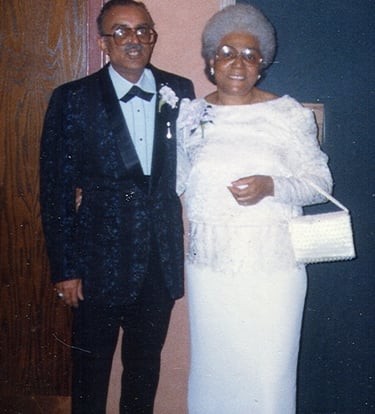
That pattern is common in family history work. And after studying my own lineage—tracing faces across four generations of parents, grandparents, and great-grandparents—I’ve come to understand both why these assumptions persist and why it is critical to challenge them.
Resemblance Is Real — But Often Misunderstood
Recently, I explored a facial recognition feature on FamilySearch that compares images across generations using artificial intelligence. The results were interesting—and in some cases affirming.
But more importantly, they reinforced something I had already learned through years of research:
Resemblance is real. Interpretation is where we often go wrong.
“You Must Have Native American in You…”
In African American genealogy circles, this statement is familiar:
“You have high cheekbones—you must have Native American ancestry.”
It is often said with certainty. Sometimes with pride.
But when I traced similar facial structures across both my maternal and paternal lines, I found no documented Native American ancestry connected to those traits. What appeared to be a defining feature pointing outward was actually something much simpler:
A repeated family trait—carried within.
The feature was not a clue to a different ancestry. It was evidence of continuity.
“That Feature Proves Parentage”
Another common assumption is that shared physical traits—such as hairline, nose shape, and facial structure—confirm direct relationships.
But genetics does not operate that simply.
Traits are influenced by multiple genes. They can appear across siblings, cousins, and extended relatives. They may even skip generations entirely.
In my own family, I observed features reappearing across different branches—not because of a direct parent-child connection, but because those traits exist within the broader family line.
A shared feature is a clue. It is rarely proof.
What Feels Unique Usually Isn’t
One of the most important lessons in this work is this:
What feels unique is often just unrecognized.
A smile. An expression. The way someone carries themselves in a photograph.
Viewed in isolation, these traits feel distinctive. But when placed side-by-side across generations, they begin to reveal something else:
Patterns. Not anomalies. Inheritance.
Not All Traits Mislead
To be clear, not every trait leads us astray.
In my own family, premature graying tells a very different story. My mother’s hair was fully gray before 40. Mine began in my early 20s and was complete by 50. Tracing backward, that same pattern appears consistently across multiple generations.
No assumption required. No interpretation needed.
Some traits follow clear genetic paths. Others—especially facial features—require caution.
Knowing the difference is part of doing this work well.
Science Supports What We See
Modern genetic research confirms what careful genealogists eventually discover:
Physical traits are influenced by many genes
They are not exclusive to a single population
Most genetic variation exists within populations, not between them
Organizations such as the National Human Genome Research Institute and the American Association of Biological Anthropologists have emphasized this point. Research highlighted by the Smithsonian Institution and consumer DNA studies from 23andMe consistently reach the same conclusion:
Visible traits are a poor predictor of ancestry.
This is not a minor detail. It is a fundamental limitation of what our eyes can tell us.
AI Can Identify Similarity — Not Meaning
Tools powered by artificial intelligence can now identify facial similarities with impressive accuracy.
In my case, the technology confirmed what I had already observed: a strong resemblance between my father and me.
That has value.
But a line must be drawn.
AI can detect resemblance. It cannot explain it.
It does not understand:
Family relationships
Historical context
Generational patterns
The difference between inherited traits and coincidence
The same tool that identifies resemblance within your family could also match you to someone unrelated.
AI is a tool. It is not a conclusion.
A Note on Family Stories
For many African American families, stories of Native American ancestry carry deep meaning. These stories often emerged during periods when records were incomplete or inaccessible.
This work is not about dismissing those stories.
It is about examining them carefully—using both documentation and modern tools—so that what we pass forward is not only meaningful, but accurate.
What My Family Taught Me
As I studied my lineage—across the Driver, Morris, Jackmon, Mapp, and Jackson lines—I began to see something consistent:
Structure repeating
Expression carrying forward
Traits refining over time
What appeared new in my generation was not new at all.
It was inherited.
Family resemblance is not a mystery to solve. It is a continuity to trace.
The Better Question
Instead of asking:
“What ancestry does this feature prove?”
Ask:
“Where else does this trait appear in the family?”
That shift moves you:
From assumption to observation
From speculation to evidence
From storytelling to pattern recognition
Final Thought
Our faces do tell stories—but not always the ones we assume.
They do not point to a single origin.
They reveal something quieter and more enduring:
Continuity.
Before accepting an assumption, go back a generation. Then another. Compare photographs. Look for patterns.
The answer you’re searching for may already be looking back at you.
What’s a family trait you’ve always wondered about—or an assumption you’ve had to rethink?
Share it in the comments, or tag a family member who needs to read this.
Follow The Driver Research Group as we continue uncovering the stories, patterns, and connections that shape who we are.
Connect With Us
To stay informed about the latest research and discoveries, connect with us on our social media channels.
© 2025. All rights reserved.
Let's Keep In Touch