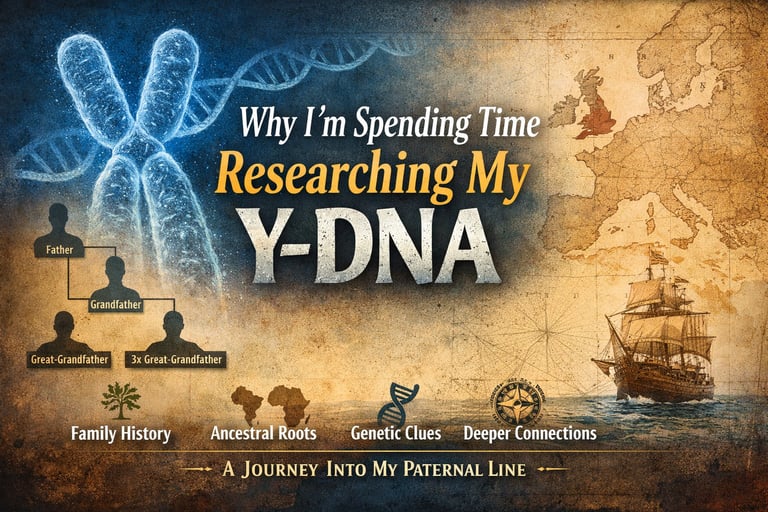
Why I’m Spending Time Researching My Y-DNA
This blog shares my curiosity-driven journey into Y-DNA research. What began more than ten years ago as a simple add-on to a basic DNA test has grown into a focused and meaningful pursuit to better understand one specific piece of my genetic story—and the deeper history it reveals.
Y-DNAFAMILYTREEDNA
Wayne Karl Driver
1/23/20263 min read
Why Am I Spending Time Researching My Y-DNA?
I did not begin this journey thinking I needed to know my Y-DNA. I knew my father was a Driver, his father was a Driver, and even my 3× great-grandfather was a Driver. What more was there to uncover?
Apparently—quite a lot.
As I continued upgrading my Y-DNA testing levels, something unexpected caught my attention: there were no Driver matches. None. That discovery alone forced me to pause and ask a difficult question—why would that be the case? The answer wasn’t simple, and it led me down a path that required both historical context and genetic science to fully understand.
Before going further, I want to acknowledge something important. Slavery robbed people of African descent of their legacy—names, places, records, and continuity. In my own research, after tracing my ancestry back to the late 1600s and uncovering a mixed-race heritage, I assumed there was a European ancestor in my paternal line. I also assumed that the ancestor was a Driver male. Y-DNA, however, challenged that assumption and required me to dig deeper into both history and DNA to make sense of what I was seeing.
When people hear DNA testing, they often think it’s about finding close relatives or learning ethnicity percentages. Y-DNA research is about something deeper: tracing the direct paternal line—father to father to father—across centuries, and sometimes millennia.
Y-DNA changes very little from generation to generation. That stability makes it one of the most powerful tools available for uncovering where a family line originated, how it migrated, and how families who appear unrelated on paper may actually share a common ancestor. For anyone researching surnames, early American families, or the pre-enslavement African and European roots of their ancestors, Y-DNA can reveal answers that traditional records never could.
To do this work, I use FamilyTreeDNA, the only major DNA testing company that specializes deeply in Y-DNA analysis.
Below is a plain-language breakdown of the different Y-DNA testing levels, what they mean, and why each one matters.
Understanding Y-DNA Testing 🧬
Only biological males can take a Y-DNA test
It follows the direct paternal line only
It is ideal for:
Surname research
Deep ancestry
Confirming or disproving family connections
Breaking long-standing genealogical brick walls
The Levels of Y-DNA Testing at FamilyTreeDNA
1️⃣ Y-37 Test – The Starting Point
Best for: Beginners or surname projects
Tests 37 markers on the Y chromosome
Can confirm whether two men are likely related
Matches typically share a common ancestor within the last few hundred years
Think of it like:
A family reunion check—“Are we from the same branch?”
Limitations:
Not precise enough for deep historical research and of limited use for very old lineages.
2️⃣ Y-67 Test – More Detail, More Clarity
Best for: Serious genealogy and line verification
Tests 67 markers
Helps separate close family branches
Improves the accuracy of ancestral timelines
Think of it like:
Zooming in from a neighborhood view to a street-level map.
Why it matters:
This level often resolves confusion among families with the same surname.
3️⃣ Y-111 Test – High-Confidence Matches
Best for: Advanced researchers
Tests 111 markers
Strong indicator of how closely two men are related
Ideal for confirming lineages back to colonial or early migration periods
Think of it like:
Comparing exact addresses instead of just city names.
This is often where real breakthroughs begin.
4️⃣ Big Y-700 – The Deep Ancestry Gold Standard
Best for: Legacy research, deep history, and scientific-level insight
Examines hundreds of thousands of markers
Identifies unique mutations (SNPs)
Places your paternal line precisely on the global Y-DNA tree
Can reveal ancestors from 1,000+ years ago
Think of it like:
A time machine that shows:
Where your line originated
When it split from other families
How it migrated across continents
Why I use Big Y-700:
It allows me to connect:
Modern descendants
Early American families (Smith vs. Driver)
African and European ancestral roots (England, Ireland, and beyond)
Pre-surname history
This level of testing helps build permanent genealogical knowledge—not just for me, but for future generations.
Why This Matters to Me (and My Family)
Y-DNA research isn’t just technical—it’s restorative.
For families whose histories were disrupted by slavery, forced migration, or lost records, Y-DNA can:
Restore ancestral connections
Rebuild erased lineages
Confirm or challenge oral histories
Reconnect families across continents
Every new Y-DNA discovery adds another brick back into a foundation that was once taken apart.
Final Thoughts
Y-DNA research is not about curiosity alone; it’s about identity, legacy, and truth.
Each testing level serves a purpose, but together they tell a powerful story:
Who we are
Where we came from
How our family fits into the larger human journey
This is why I spend time researching my Y-DNA. Some answers can only be found in the chromosome that fathers pass to their sons.
What will knowing this information do for me in a tangible sense? Probably nothing. But it gives me something far more meaningful—a clearer understanding of my ancestors’ journey.
This year, I will be visiting the United Kingdom, where my Y-DNA originates. I don’t expect to see people who look like me, but I do expect to gain insight into why my male ancestors made the journey to the Americas.
In upcoming blogs, I’ll share what I’ve discovered and where my research is headed next. I’ve also had the opportunity to test a maternal male cousin, which I hope will shed light on my maternal grandfather’s ancestry. He remains a mystery—one I’m determined to resolve.
Connect With Us
To stay informed about the latest research and discoveries, connect with us on our social media channels.
© 2025. All rights reserved.
Let's Keep In Touch